
The New Starlink REV5 Terminals: What We Know So Far
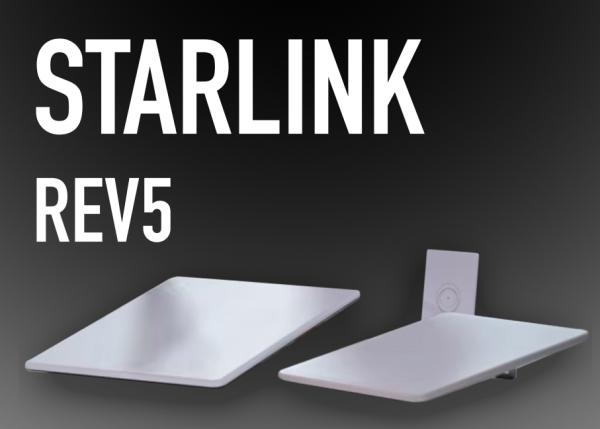
Recent discussion around the next generation of Starlink terminals has gathered pace following a new Elon Musk interview, in which two smaller Starlink antennas were shown publicly.
Further technical detail has also emerged from Oleg Kutkov, who has posted analysis based on data extracted from recent Starlink firmware updates.
At this stage, the information available should be treated as early and partly speculative. Starlink has not yet published full product specifications, launch dates or regional availability. However, enough information is now circulating to form a sensible view of where the range may be heading.
There appear to be two new terminals under discussion:
- A smaller replacement for the Standard REV4, the Standard REV5
- A rugged replacement for the MINI with a built-in battery and WiFi router, the MINI Rugged
Standard REV5: what we know so far
Based on Oleg Kutkov’s firmware analysis, the new Standard REV5 appears to sit physically between the current Standard REV4/Gen3 dish and the Starlink Mini.
The reported panel size is around 274 × 350mm, making it much smaller than the current Standard REV4 and only slightly larger than the current Mini.
Reported details include:
- Approximate panel size: 274 × 350mm
- Thinner
- Input power: 54V
- Maximum power: 111W
- Ethernet port: 1G
- No GPS - Starlink Satellite Location Better than traditional GPS
- Power delivered over the Ethernet cable
- Likely to use Starlink’s own PoE-style arrangement rather than standard PoE++
This suggests the new Standard REV5 terminal could become the more obvious choice for permanent installation on vehicles, RVs, campervans and boats. It appears to offer a smaller physical footprint than the current Standard dish, while retaining the more conventional cabled installation approach.
For DC-powered installations, the key question is whether Starlink keeps the same broad power architecture used by the current Standard terminal. If the new terminal continues to use a 54V Starlink-style PoE arrangement, products such as DishyNOAC Pro are likely to remain relevant.
MINI Rugged: what we know so far
The second terminal appears to be a new ruggedised MINI style device. Current reports suggest this is not simply a replacement for the existing Mini, but a more standalone product.
The expected features include:
- Built-in lithium battery
- USB-C charging
- Ethernet port
- Integrated WiFi router
- Ruggedised portable design
This points towards a device designed for rapid deployment, temporary use and portable connectivity. In simple terms, it appears to be the type of terminal you can carry, place on the ground, power from its internal battery and charge via USB-C, and use for “anywhere” internet access.
That is a different use case from permanently mounting a Starlink terminal on the roof of a vehicle, RV or boat.
What is still not known
There are several important questions that remain unanswered.
Will the new MINI support PoE?
This is one of the biggest questions from an installation perspective.
Some are hoping that the new MINI Rugged will support PoE via its Ethernet port. That would allow power and data over a single cable, which is useful when the dish is outside and WiFi reception is required inside.
However, the presence of an integrated battery and USB-C charging may indicate that Starlink is moving this device towards a more self-contained portable use case, rather than a permanently wired installation.
When will the new terminals be released?
There is speculation that the new terminals may arrive early next quarter, but no firm public release date has been confirmed.
Based on previous Starlink releases, it is possible the new terminals could initially be offered alongside the existing range, rather than replacing it immediately. This is similar to the way Starlink has previously introduced newer hardware for the Performance range, offering the new and older terminals as options at checkout.
Will the terminals be available globally from day one?
This is also uncertain.
The current Standard REV4 initially launched in the US before wider availability followed later. That staggered release may have been related to stock availability, regional certification or both.
Given the recent suggestion that the new terminals are currently being mass produced in the US, a wider launch may be possible. However, until Starlink confirms availability by region, it would be sensible to assume that some markets may receive the new hardware before others.
How much will the new terminals cost?
Pricing is not yet known.
Historically, new Starlink hardware has not launched at the same discounted pricing seen on mature products.
For example, when the MINI first launched in the UK in 2024, the delivered price including taxes was £419. Contrast that with today’s price of £179 + £19 shipping.
The current Mini has often been available at very attractive pricing, particularly compared with where new hardware is likely to sit at launch.
The MINI Rugged is especially likely to cost more than the current Mini, mainly because an integrated lithium battery adds meaningful cost, weight and complexity.
This matters for permanent installations. If the terminal is mounted on a vehicle or boat with an existing leisure power system, paying extra for an integrated battery may not make much practical sense.
Will the new terminals support faster or more symmetrical speeds?
There has been discussion around whether the new terminals will support higher speeds and potentially more symmetrical upload and download performance.
Oleg Kutkov’s technical analysis suggests the new phased-array design may support improved performance, but the terminal is only one part of the system. The real limiting factor is likely to be the satellite constellation itself.
Starlink’s next generation V3 satellites are expected to deliver much greater capacity, with significantly higher downlink and uplink capability. However, those satellites need to be launched and deployed in sufficient numbers before users can expect consistent real-world benefits.
This means that even if the new terminals are technically capable of higher speeds, those benefits may not be fully realised until the satellite network catches up.
What conclusions can be drawn?
The direction of travel appears reasonably clear.
Starlink seems to be repositioning the range so that the MINI becomes more of a portable, standalone device, while the smaller REV5 Standard becomes the more practical option for fixed or semi-permanent installations.
That would make sense.
The current Mini has become popular for vehicle and off-grid use because of its low power consumption, compact size and attractive pricing. However, if the new MINI Rugged includes a built-in battery and USB-C charging, it starts to look less like a permanent roof-mounted terminal and more like a portable communications device.
For a campervan, RV, expedition vehicle or boat, a built-in battery is not necessarily an advantage. These vehicles already have a leisure power system. In that context, the priority is usually:
- Efficient DC power
- Reliable Ethernet
- A clean cable route
- A router located inside the vehicle
- A permanently mounted external terminal
That points more towards a smaller Standard REV5 terminal than a battery-equipped MINI.
The reported REV5 Standard appears to offer exactly that direction: smaller size, lower power than the current REV4 and continued Ethernet-based power delivery.
Should you wait for the new terminals?
If you always want the newest hardware, then waiting for the REV5 terminals may make sense.
However, for many users, the current Starlink Mini and Standard terminals remain the more practical choice, especially while they are available at discounted pricing.
There are several reasons for this.
First, the current Mini is likely to remain one of the lowest-cost Starlink terminals available for some time. If the MINI Rugged launches with an integrated lithium battery, it is reasonable to expect a higher price point.
Second, the new terminals may not deliver their full performance benefits immediately. The wider network needs enough next-generation satellites in orbit before customers can consistently benefit from the higher speeds being discussed.
Third, the accessory ecosystem for the current Mini and Standard terminals is already mature. Mounts, DC power solutions, cables and installation practices are well understood. New hardware often takes time to settle, particularly for vehicle, marine and off-grid installations.
For many customers, the best value route may be to take advantage of current Mini or Standard pricing now, then consider an upgrade once the REV5 terminals have been properly tested, reviewed and supported by a mature accessory ecosystem.
Our current view is that the existing Mini may remain the cheapest Starlink option for some time. It may also hold its resale value well, depending on the eventual price of the REV5 Standard and MINI Rugged.
Final thoughts
The new Starlink REV5 range looks like a meaningful hardware reset.
The smaller Standard terminal may become the natural choice for permanent vehicle, RV and marine installations, especially as it retains Ethernet-based power delivery and offers lower power consumption than the current REV4.
The MINI Rugged, meanwhile, appears to be moving towards a different use case: portable, battery-powered, standalone internet access.
That distinction matters.
For a permanent off-grid installation, the question is not simply which terminal is newest. The more important question is which terminal gives the best balance of power efficiency, installation simplicity, reliability, cost and compatibility.
Until the new terminals are officially released and tested, the current Mini and Standard terminals remain strong options, particularly for customers looking for proven hardware and a mature installation ecosystem.